
A show does not begin when the lights come on. It starts much earlier, in a process made of ideas, discussions, renders, technical solutions, revisions, rehearsals and choices that must turn a creative intuition into a live experience.
At MIR26, the talk “Making of the Show: from Concept to Stage Marco Mengoni Live 2025” brought to the MIR Arena stage some of the professionals involved in the creation of Marco Mengoni’s 2025 tour. The session explored the backstage of show design, focusing on the journey that transformed a creative concept into a complex live production, designed for stadiums and built as a true concert-opera.
Moderated by Giancarlo Messina from Show Gear Network, the panel featured Simona Muti, Creative Supervisor and Head of Creative Department for Marco Mengoni and Creative Supervisor for LaTarma Entertainment; Gianluca Carrozzo, Production Director for Live Nation; Jordan Babev and Davide Pedrotti, Lighting Designers for Blearred; Lorenzo De Pascalis, Creative Director for Ombra; and Alberto Butturini, Sound Engineer.
The panel explored, department by department, how set design, lighting, video, automation, audio and artistic direction worked together to create a show where technology was not simply an effect, but a narrative language.
The concept: a concert inspired by Greek tragedy
At the heart of the show was a clear idea: not to create a traditional concert, but to shape an emotional journey. As Simona Muti explained, the project came from Marco Mengoni’s desire to bring something to the stage that went beyond a sequence of songs, bringing pop closer to the world of opera and Greek tragedy.
The story of the show unfolded in acts, starting from an image of destruction and solitude and gradually moving towards reconstruction, liberation and final catharsis. The initial ruins, the city coming back together, the structures changing visual density, the suspended bridge and the brighter, more celebratory final section were not isolated elements, but stages of a narrative.
This is perhaps the first lesson that emerged from the talk: in a high-level live production, technology truly works when it serves an idea. It is not about adding effects to impress, but about understanding what the audience should feel at every moment of the show.
Set design and lighting design: when the stage becomes storytelling
The work on set design and lighting followed the same narrative direction. The Blearred team explained how the scenography started from the world of ruins, created with an almost artisanal approach, and then evolved towards an abstract, crystalline city, increasingly transparent and luminous.
The stage had to change its appearance throughout the evening. Someone entering at three different moments of the show should have seen three different visual pictures. This objective guided both the set and lighting design, creating a complex challenge: building a visually powerful structure that never became invasive, while leaving space for video, movement, performance and voice.
One of the most interesting points that emerged from the discussion concerned the balance between departments. In a show with such a strong presence of lighting, video, automation and effects, the risk is that each element tries to overpower the others. In this case, the creative work moved in the opposite direction: removing when necessary, leaving empty spaces, using only a few lights in certain moments, allowing the scene to breathe.
The result was a show design where technological power was always at the service of dramaturgy.
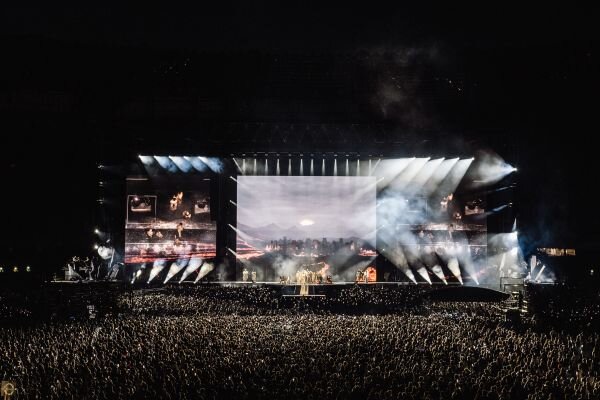
Credits Photo: Comunicarlo
Live audio: delivering emotion without losing control
In such a visually imposing show, audio had a delicate task: to deliver the artistic intention to the audience without being overwhelmed by the complexity of the stage.
Alberto Butturini, Marco Mengoni’s sound engineer for many years, explained how the stage layout required specific audio choices. The band was positioned on the sides of the stage, while the central area was dedicated to Marco and the performers. This configuration, together with the presence of clusters, subs and musicians placed in unconventional areas, required an extremely controlled audio design.
The system had to guarantee intelligibility, impact and consistency, while avoiding spill and interference in the low frequencies. The tour involved around 120 to 130 audio channels and a double control setup, with careful management of sequences and transitions.
Butturini highlighted an important point: in such a carefully constructed show, the sound engineer becomes the final point of reception for the entire artistic process. If set design, lighting, video and direction build the emotion, audio must allow that same emotion to reach the audience in a full, natural and powerful way.
Video design and visual content: from 3D to the live stage
The video component, curated by Ombra, played a central role in shaping the visual world of the show. Lorenzo De Pascalis described the work on visual content as a path running parallel to the scenography: the video also had to start from a destroyed world and accompany its transformation into a more transparent, luminous and free dimension.
One of the most complex elements was the opening song, conceived as a large visual sequence shot. Its creation required 3D content, ultra-high-resolution renders and meticulous work on digital materials: rock, glass, refractions, transparencies and colour became integral parts of the set design.
Video was therefore not a background, but an independent narrative layer. It had to interact with live cameras, the physical set and the movement of the screens, maintaining continuity between what was happening on stage and what was being projected.
Here too, one of the key themes for professionals working in the audiovisual sector clearly emerged: integration. Video, lighting and scenography cannot be designed as separate compartments. They must move together, with a shared grammar.
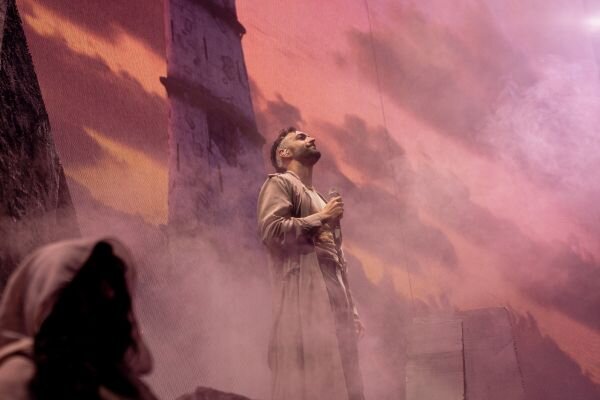
Credits Photo: Comunicarlo
The bridge, screens and automation: the challenge of live production
Among the most spectacular and complex elements of the tour was the moving bridge, a walkway of around 25 metres that allowed Marco Mengoni to get closer to the audience, moving and rising during the show. It was a very strong idea from a symbolic and scenic point of view, but extremely demanding from a production perspective.
Gianluca Carrozzo described the work required to turn creative ideas into solutions that could actually be assembled, transported and replicated on tour. The production travelled with 28 articulated trucks and had to be assembled in around 12 hours. The bridge alone weighed several tonnes and required a crane for assembly, although it had been engineered to reduce setup time as much as possible.
Added to this were the moving screens: eight video totems weighing around two tonnes each, controlled through a complex system of motors and movements. Every element had to operate safely, adapting to resident stages and conditions that changed from venue to venue.
Weather, especially wind, was a decisive variable. For this reason, the team had prepared several alternative plans, with specific procedures in case of critical conditions. In a live production of this scale, spectacle is only the visible part. Behind it lies a machine made of timing, safety, logistics and the ability to make fast decisions.
Timecode, show direction and coordination: invisible precision
A show this complex can only work with a rigorous coordination structure. Lighting, audio, automation, video, music, performers and stage movements were all linked to precise time management.
Every change had cascading effects across several departments. Every movement had to be planned, called and controlled.
In this context, the role of show director held by Lorenzo De Pascalis was fundamental. It was not just about following the show from a creative point of view, but about coordinating actions in real time, ensuring safety and making sure everything happened at the right moment. Moving screens, performers on stage, flames, the mobile bridge, lighting changes and video content all had to coexist with no margin for error.
It is a part of live production that often remains invisible to the audience, but is decisive for the success of the show.
Technology works when it has a purpose
The “Making of the Show” talk clearly showed what designing a major live production means today: bringing together creativity, technical expertise, artistic sensitivity and production capability.
Marco Mengoni’s 2025 tour was not presented as a race to create the biggest effect, but as an example of integration between departments. Technology was massively present, but always with a function: to shape a story, amplify an emotion, bring the artist closer to the audience and transform the stadium into a theatrical space.
And this is precisely what makes the project so interesting for professionals working in audio, video, lighting design, production and show business: every technical choice came from a creative question.
How do you tell the story of rebirth? How do you transform a city of ruins into a city of light? How do you bring an artist closer to tens of thousands of people? How do you combine the power of a stadium with the precision of an opera?
At #MIR26, these questions became an opportunity for dialogue, training and inspiration. Because the future of entertainment technology is not only shaped by increasingly advanced tools, but by the ability to use them to create memorable live experiences.
PUBLICATION
16/06/2026
caso studio scenario
Other related news
23/07/2024
AmiciXSempre live 2023: all the secrets behind the Pooh tour
03/06/2025
Backstage Festival: the technologies and strategies behind a successful event
04/04/2025
How AI is redefining meeting rooms and workspaces as a whole
11/10/2024
Corporate events: which technologies are essential?

10/07/2026
AI and Creativity: What Remains Human in Entertainment?
29/07/2026
IMS Ibiza 2026: what does it reveal about the future of electronic music?

10/06/2026
The Live Sound Engineer’s Job: Technique, Listening and Advice from Alberto Butturini
25/07/2023
Interview with Andrea Corsellini, Vasco Rossi’s sound engineer
30/11/2023
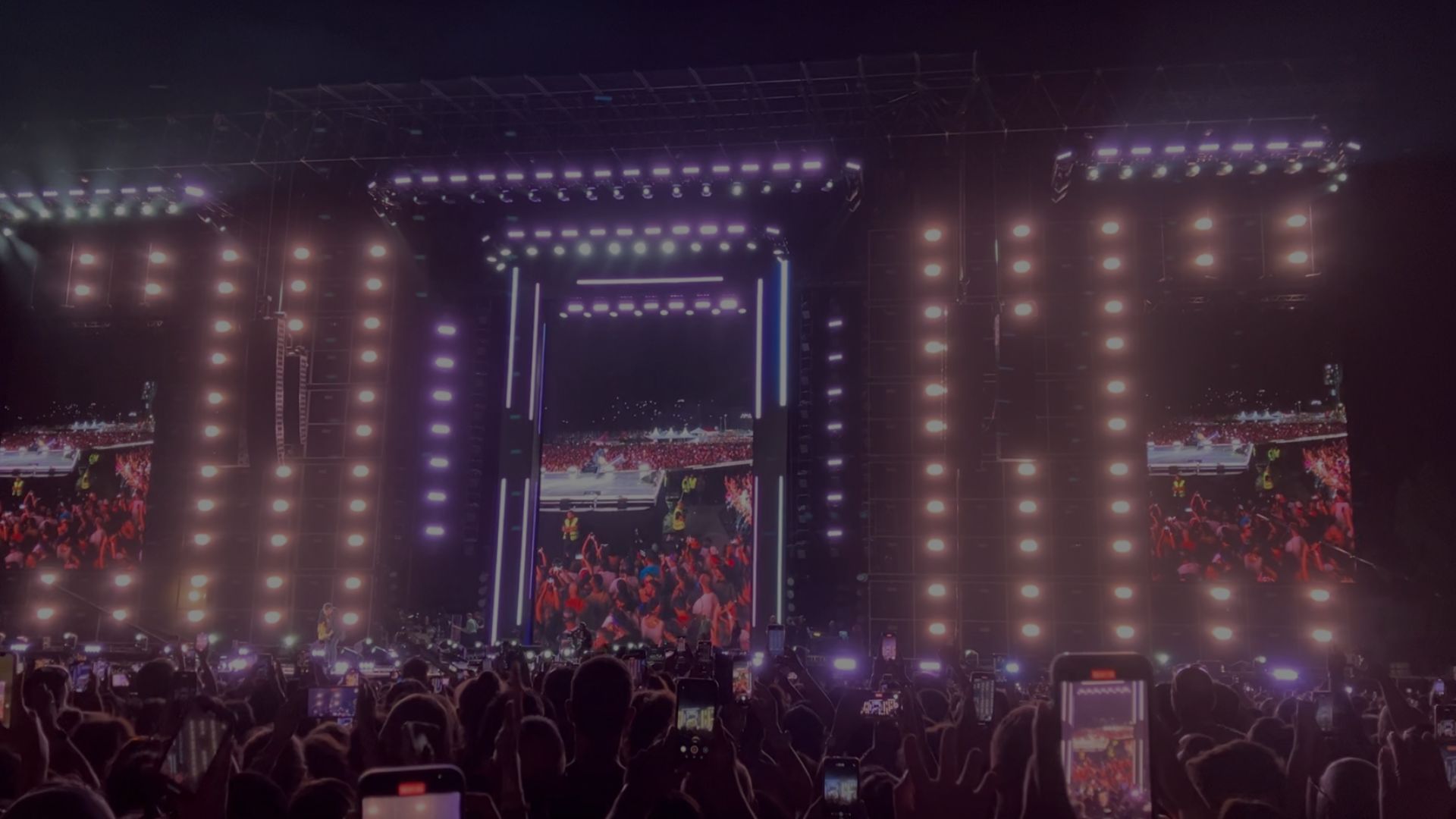
The creative concept behind a major concert: the case of Cesare Cremonini

20/12/2022
Learning goes digital: how technology is transforming education
24/11/2023
Music as a tool for territorial marketing
20/03/2025
LAMPOshop at MIR 2025: innovation, quality and showmanship
05/09/2024
Lighting designer: who is one and how to become one?

02/03/2026
MIR Club 2026: All Events from April 12 to 14

27/03/2026
MIRIllumino: Anonymous Light Showcase at MIR26 to Test and Vote Lighting Live
17/01/2024
Corporate museum: what it is and what technologies to use