
Artificial intelligence is no longer a technology to be observed from a distance. It has already entered the creative, production and distribution processes of music, audiovisual content and entertainment: it generates content, supports post-production, automates technical tasks, suggests solutions, analyses data and opens up new possibilities for artists, producers, technicians and creative companies.
But if a machine can compose, imitate, edit, write and make decisions, what space remains for human creativity?
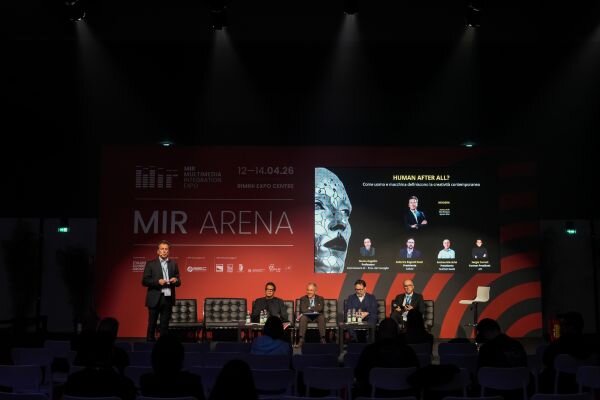
This was the starting point for “Human After All? How Humans and Machines Define Contemporary Creativity”, the event that opened MIR26 and placed at the centre of the debate the relationship between artificial intelligence, the music industry, entertainment, copyright, economic models and technology governance.
On stage, institutions, representatives of the music and audiovisual supply chain, legal experts and technology specialists came together for the discussion: Brando Benifei, Member of the European Parliament and rapporteur for the AI Act; Marco Angelini, Associate Professor in Computer Engineering at Link Campus University in Rome and member of the Government’s AI Commission; Sergio Cerruti, former President of AFI; Andrea Miccichè, President of Nuovo IMAIE; Bruno Sconocchia, President of Assoconcerti; and Federico Bagnoli Rossi, President of FAPAV.
Artificial Intelligence and Creativity: Real Opportunities, Concrete Risks
In his speech, Brando Benifei pointed out that artificial intelligence is already present in the cultural industries. In music and audiovisual production, it is used to automate editing, sound cleaning, translations, subtitles, text drafts, images and content. This is therefore not a future scenario, but a transformation that is already underway.
This shift opens up major opportunities. AI can lower entry barriers, allow smaller organisations to experiment with new languages, free up time from repetitive tasks and help create increasingly complex immersive experiences. For a supply chain such as MIR’s, where audio, video, lighting, control, broadcast, DJing and live production meet, artificial intelligence represents a new field of innovation.
But Benifei also highlighted the critical side: many models are trained on huge quantities of content, often without specific agreements with those who created those works. The risk is that creative work becomes free raw material for tools that then compete in the same market as artists, producers and cultural businesses.
Rights, Transparency and the AI Act: Why Rules Are Needed
One of the key issues that emerged from the debate concerns the relationship between AI and copyright. If a model is trained on music catalogues, audiovisual works, voices, images or performances, the question is not only technical: it is economic, legal and cultural.
Benifei recalled the role of the AI Act as a European framework for setting clearer rules. In particular, he emphasised the need for model providers to respect copyright, make the data used for training more transparent and allow artificially generated content to be recognised.
The goal is not to stop innovation, but to prevent technology from creating a fracture in value chains. In a sector made up also of micro-businesses, freelancers, independent labels, service providers, festivals and specialised professionals, protecting rights becomes a condition for making technological evolution sustainable.
Creativity as Data: Nuovo IMAIE’s Point of View
On the protection of artists, Andrea Miccichè introduced a crucial point: artificial intelligence can reproduce deeply personal elements such as voice, timbre, physical appearance, gestures and interpretative traits.
For this reason, according to Miccichè, the issue of prior authorisation is decisive. Not everything that is not forbidden should automatically be allowed. On the contrary, the use of works, performances or artistic identities should only be possible within clear, authorised and limited boundaries.
This point is particularly delicate for artists, performers and musicians, who are often the weaker party in contractual relationships. The generic and unlimited transfer of rights, especially in a context where AI can reuse and transform an artistic identity, risks creating even deeper imbalances.
Generative AI: Not an Oracle, but a Tool to Be Governed
Marco Angelini explained how generative artificial intelligence models work. AI does not create like a human being: it works on data, statistical relationships and probabilistic models. It can generate texts, images, sounds or content because it has learned from enormous amounts of information, not because it has intention, experience or awareness.
This aspect is crucial to understanding the relationship between AI and contemporary creativity. Angelini explained that, in the creative field, even the so-called “hallucinations” of models can become a space for experimentation: deviations, unexpected combinations and possibilities that creative professionals can interpret and transform into language.
At the same time, however, when a model becomes too close to the data it was trained on, the risk of plagiarism or unintentional imitation of existing works, brands and styles increases. This is why AI cannot be treated as autopilot. Critical thinking is needed, supervision is needed, and so is a technical culture capable of distinguishing between acceleration and delegation.
Ethics, Market and Responsibility: AFI’s Position
Sergio Cerruti brought the debate back to an industrial and ethical level. Music and entertainment are complex production chains, made up of professions that cannot be reduced to passion alone: musicians, producers, sound engineers, technicians, companies and operators build economic, cultural and social value.
According to Cerruti, the point is not to oppose technological progress, but to avoid being subjected to it. The history of music has already been shaped by innovations that changed the way music is produced, composed and distributed. Artificial intelligence, however, introduces a new speed and scale.
The risk is that business models are built first, while the market is asked to adapt afterwards. In this scenario, ethical responsibility becomes central: authorisation should be requested first in order to use other people’s content and expertise, and only then should value be built on that basis. Not the other way around.
AI as a Protection Tool: Its Role in Anti-Piracy
Another point of view was brought by Federico Bagnoli Rossi, President of FAPAV. Artificial intelligence, he explained, is not only a threat to the creative industries: it can also become a protection tool.
In the audiovisual sector, AI is already used to monitor content, detect infringements, support anti-piracy activities and strengthen the protection of works. Bagnoli Rossi also highlighted the potential of artificial intelligence in post-production, when it is integrated into a process guided by human work.
The issue is understanding how to integrate it correctly into creative and industrial processes, preventing it from becoming an uncontrolled shortcut or an indiscriminate replacement.
Human After All: The Future Remains a Human Choice
The question that gave the event its title remains open: will we still be “human after all”?
The answer that emerged at MIR26 was not a defensive rejection of innovation. On the contrary, the debate showed that artificial intelligence can become a powerful accelerator for music, audiovisual production, live entertainment and content creation.
But for this to happen, awareness, rules, skills and responsibility are needed. AI can generate, imitate, combine and accelerate. What it cannot replace are critical judgement, intention, experience, emotion and the human ability to give meaning to what is created.
For MIR, which places audiovisual and entertainment technologies at the centre, this discussion is an integral part of the sector’s transformation. The future will be increasingly technological. The real challenge will be making sure it also remains deeply human.
PUBLICATION
10/07/2026
Other related news
23/07/2024
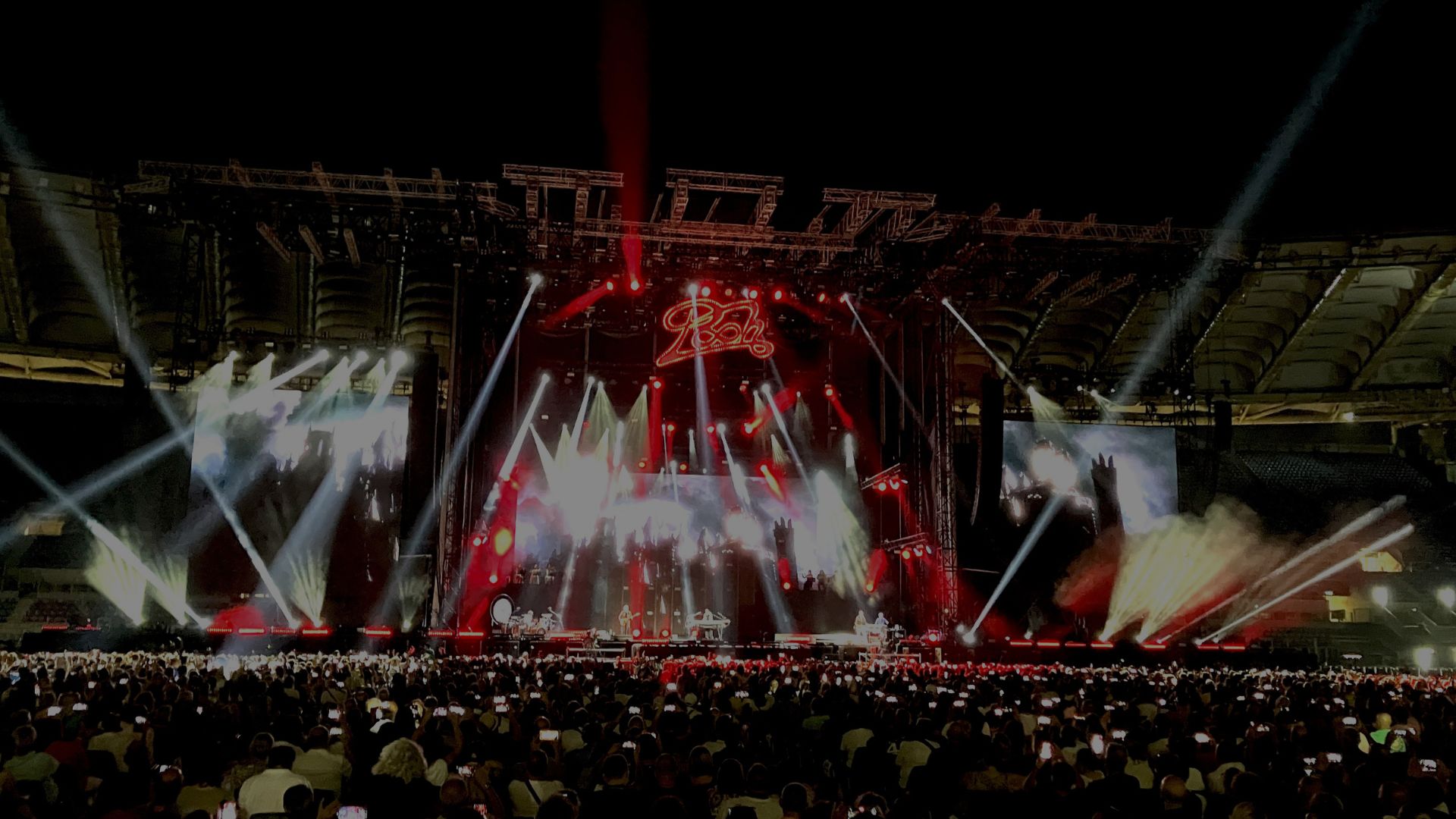
AmiciXSempre live 2023: all the secrets behind the Pooh tour
03/06/2025
Backstage Festival: the technologies and strategies behind a successful event

04/04/2025
How AI is redefining meeting rooms and workspaces as a whole
11/10/2024
Corporate events: which technologies are essential?
29/07/2026
IMS Ibiza 2026: what does it reveal about the future of electronic music?

10/06/2026
The Live Sound Engineer’s Job: Technique, Listening and Advice from Alberto Butturini
25/07/2023
Interview with Andrea Corsellini, Vasco Rossi’s sound engineer
30/11/2023
The creative concept behind a major concert: the case of Cesare Cremonini
20/12/2022
Learning goes digital: how technology is transforming education

24/11/2023
Music as a tool for territorial marketing

20/03/2025
LAMPOshop at MIR 2025: innovation, quality and showmanship
05/09/2024
Lighting designer: who is one and how to become one?

02/03/2026
MIR Club 2026: All Events from April 12 to 14

27/03/2026
MIRIllumino: Anonymous Light Showcase at MIR26 to Test and Vote Lighting Live

16/06/2026
Making of the Show: Marco Mengoni Tour Show Design
17/01/2024
Corporate museum: what it is and what technologies to use