
Artificial intelligence can generate a song, develop an unfinished idea, create an arrangement and suggest new directions to a producer. But how much of that result can truly be considered creation? And what changes for those who produce music every day?
At MIR26, the panel “Suno o Suono” addressed the topic directly from the perspective of studio practice.
The guests taking part in the discussion were Roberto Intrallazzi e Luca Provera (The Cube Guys), Chicca Leaf (Cleo Recordings / DJ Mag Italia), Max Giorgetti (Major Lab), the producer Simone Barbaresi and Danny Losito (Double Dee).
Through live demonstrations, experiments with generated tracks and reflections on the future of music production, the panel highlighted one point with particular clarity: AI can already enter the creative process, but its value still depends on how it is used.
What Is Suno and How Does It Work?
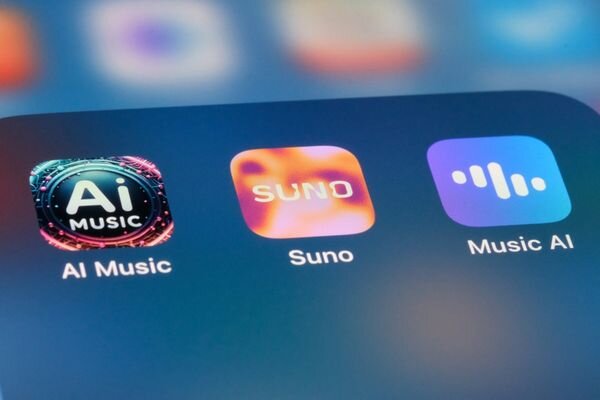
Suno is a generative artificial intelligence platform applied to music, capable of creating or reworking tracks based on the instructions provided by the user.
During the panel, several concrete examples were shown. In one case, Suno was used to generate a track with a Seventies sound, between funk, soul and nu-disco, starting from a prompt that indicated style, vocal characteristics, instrumentation and sonic references.
In another experiment, however, the starting point was a house draft already created by the producer, mainly composed of groove and samples. Artificial intelligence then intervened by developing that idea and returning a new version of the track.
This also helps explain how Suno works in music production. It is not enough to ask generically for a song to be created: the more precise the prompt, the more possible it becomes to guide the result. Genre, mood, arrangement, voice and references become instructions used to steer the generation.
However, a degree of unpredictability remains. Even when using the same input, the system can return very different results.
Suno as a Creative Assistant in the Studio
One of the most interesting uses that emerged from the discussion is Suno as support for the creative process.
It can be useful, for example, when a production reaches a dead end. A loop works, the groove is there, but a direction is missing. In these cases, AI can quickly develop a possible continuation, propose a different arrangement or suggest elements that the producer can then choose to use, modify or discard.
The work can then return to the DAW, where what has been generated is reworked again through traditional tools and skills.
It is a dynamic that brings Suno closer to an assistant than to a replacement. It can shorten certain stages, help test an idea quickly and offer a stimulus when the creative process gets stuck.
From this point of view, artificial intelligence fits into a history already shaped by other major technological transformations: samplers, sequencers, production software and digital tools have already changed the way music is composed and produced, without eliminating the role of those who use them.
AI and Music Production: How Much Does Human Work Still Matter?
The panel suggested a mainly hybrid vision. The most interesting solution today does not seem to be entrusting the entire process to AI, but integrating what it generates into a broader production.
Suno allows, for example, separate parts of a track to be exported and only certain elements to be used. A track can therefore be combined with recorded instruments, new arrangements, mixing interventions, structural changes and other artistic choices.
Artificial intelligence can create many possibilities in just a few seconds, but it is still necessary to decide which ones are truly useful. Musical culture, experience, sensitivity and the ability to recognise what works become even more important when the amount of available material increases.
How Does Suno Sound? The Technical Limits of AI
From an audio quality point of view, Suno has already achieved significant results, but it is not without limitations.
During the discussion, several critical issues were highlighted, linked to transients, spectrum, sound density and harmonics. Quality can also change significantly from one generation to another, even when inputs and prompts remain similar.
And this is precisely where professional production comes back into play.
An element generated by AI may be musically interesting but not yet adequate from a sonic point of view. The producer can then select it, modify it and place it within a mix built with greater control.
The integration between AI and studio skills therefore appears, at least for now, more effective than fully automated generation.
Can Artificial Intelligence Create a Hit?
Suno can quickly generate a track that is potentially suitable for a social trend. But the possibility of obtaining instant content does not necessarily equal the ability to create a hit that is built to last.
During the panel, an important distinction emerged between momentary success and long-term value.
A track can go viral for a few weeks and then disappear. A production capable of creating a bond with listeners follows much more complex dynamics, which cannot be reduced to a formula or a prompt.
Technology does not eliminate the uncertainty that has always characterised the music industry either. Even productions created by professionals, with high-level musicians and great artistic care, may fail to achieve success.
AI can change the tools. It does not make the audience’s response predictable.

Suno, Copyright and Rights on AI-Generated Music
The most complex issue remains the question of rights on music created with artificial intelligence.
One particularly important point concerns the difference between a track generated entirely by AI and a production in which artificial intelligence intervenes only at certain stages.
A producer can start from their own composition, use Suno to develop some ideas and then intervene again with arrangement, recordings, mixing and production. This is a very different situation from full generation through a prompt.
The weight of human intervention could therefore become one of the central elements in establishing how these works should be protected and managed.
However, the discussion did not produce a definitive answer. Rules, deposit procedures and platform policies are still evolving, which is why every professional use of AI must currently be assessed with care.
Will the Future of Music Production Be Hybrid?
The discussion held in the MIR Club area suggests a clear direction: Suno can become a fast laboratory for developing ideas, testing arrangements, generating material and overcoming creative blocks. It can make production more accessible and transform the way musicians and producers build their workflows.
But precisely because it allows so much to be generated so quickly, knowing how to choose becomes even more important.
The difference may therefore gradually shift from the ability to produce a sound to the ability to recognise it, transform it and place it within an artistic vision.
Artificial intelligence increases the tools available. Sound, however, still needs direction.
PUBLICATION
31/08/2026
Other related news
23/07/2024
AmiciXSempre live 2023: all the secrets behind the Pooh tour

03/06/2025
Backstage Festival: the technologies and strategies behind a successful event

04/04/2025
How AI is redefining meeting rooms and workspaces as a whole
11/10/2024
Corporate events: which technologies are essential?

10/07/2026
AI and Creativity: What Remains Human in Entertainment?

29/07/2026
IMS Ibiza 2026: what does it reveal about the future of electronic music?

10/06/2026
The Live Sound Engineer’s Job: Technique, Listening and Advice from Alberto Butturini
25/07/2023
Interview with Andrea Corsellini, Vasco Rossi’s sound engineer
30/11/2023
The creative concept behind a major concert: the case of Cesare Cremonini

20/12/2022
Learning goes digital: how technology is transforming education

24/11/2023
Music as a tool for territorial marketing

20/03/2025
LAMPOshop at MIR 2025: innovation, quality and showmanship
05/09/2024
Lighting designer: who is one and how to become one?

02/03/2026
MIR Club 2026: All Events from April 12 to 14

27/03/2026
MIRIllumino: Anonymous Light Showcase at MIR26 to Test and Vote Lighting Live

16/06/2026
Making of the Show: Marco Mengoni Tour Show Design